WONDERFUL IBERVILLEA
Valery Zlotin, Moscow
(article was published in “Floriculture” magazine, #6/2002, p. 47)
Translation by Anne Dourtseva, Samara
There’s a great deal of species with tuber roots and thickened stem, called caudex, in some genera of the Cucurbitaceae family. Plants from the genus Ibervillea are caudex plants. They are widely spread in the South-East of the USA and north-eastern states of Mexico. Nowadays these plants are steadily gaining popularity among those fond of caudex succulents. The caudex of this plant can measure up to 50-60 cm. At present there are 8 species included into genus Ibervillea, and they are divided into 2 groups.
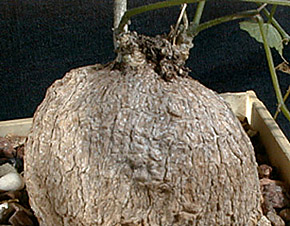 |
| Ibervillea lindheimeri |
Group 1 combines plants with simple or globular stems and annual shoots. Leaves are plain or fuzzy, flowers diurnal, fruits are not large, measuring 2 or 3 cm in diameter (Ibervillea lindheimeri, I. sonorae, I. tenuisecta, I. millspaughii).
Group 2 combines plants with branching stems and perennial shoots. Leaves are rough, flowers nocturnal, fruits large, oblong, 10-15 cm long (Ibervillea fusiformis, I. maxima, I. hypoleuca, I. guatemalensis).
Ibervillea is an extremely drought-resistant plant. Its caudex evaporates less water than cacti do. It is a known fact that an 8 kilo specimen of Ibervillea sonorae was put into a hermetic display case in a New York museum and it produced new shoots for eight years running. When the plant was taken out of the case it was alive, though lost about half of its caudex initial weight.
These plants are quite undemanding if kept in a green-house. The main way to successful cultivation is to give them porous highly penetrable potting mix. In summer they take full sun, plenty of watering and fertilizing. In winter Ibervilleas are kept absolutely dry at low temperatures (above zero).
Plant and photo by the author