EXPERIMENTS
The editor's desk. The devotees of the pure species are trying hard to preserve natural primary state of cacti but human curiosity can not be limited. And will it be? Notice that there is no need in special experiments to obtain new interesting hybrids but you should only watch carefully your seedlings and bring to light unusual forms.
My Gymnocalycium horstii
By Vladimir Boxer (Angarsk)
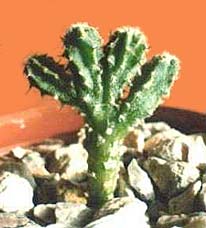
Some years ago one of the seedlings of Gymnocalycium horstii (Photo 1) sowed in winter got white. Not having a good stock I grafted it onto a small Echinopsis. For about two years it was of a beautiful pink color, then it changed for yellow. From time to time green color appears too.
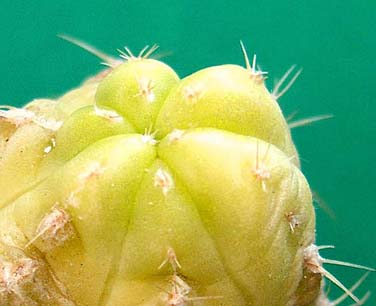
Of course, it was not without a negative influence of the stock. I believe that after Myrtillocactus slowly growing species like Trichocereus macrogonus are the best for red and yellow forms. Colored forms get green on strong fast growing stocks like Echinopsis, Hylocereus and others (as well as in the darkness).
The hybrids from germination
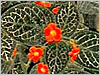
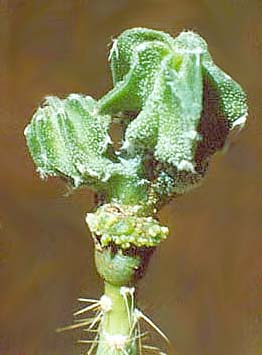
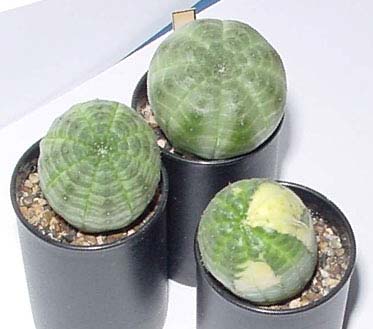
I am sending you the photographs of my Euphorbias (Photo 2). One of plants is variegated. Germination was made on January 1, 2001. Perhaps this could be a reason of variegation. Best regards, Alexander Nepryakhin.
 Intergeneric hybrids
Nikolay Balashov, Ph.D., professor, Moscow
I was trying to obtain colored forms of Astrophytum capricorne growing on their own roots. In 1998 I made cross pollination (Astrophytum. x Mammillaria. x Gymnocalycium, different species) combining it with self pollination and stimulating by nitric acid vapor. Sixty seedlings (more than 50%) were colored in different hues. The most of them were yellow or partially pink. They grew under the cover and died out one by one especially fully colored. However few of them have survived for almost a year. As of today (15.03.2001) only eight of them remain and they are mostly variegated with 1 to 3 yellow ribs and over half of bodies - green. Among seedlings there were six specimens without ribs (round ones) growing with difficulties and only 4 of them survived.
Hybridization surprise
Irina Ovchinnikova, Krivoy Rog (Ukraine)
I'm not an adherent of hybridization but temptation to cross pollinate blooming for 5 years Pseudolobivia obrepanda x Pseudolobivia ancistrophora was too big. Seeds germinated not very well but there were about twenty pure white seedlings. A week later the top of seedlings got crimson tint. I managed to graft thirteen seedlings. Now plantlets are 1-2 centimeters in diameter and have beautiful pink-crimson color. One of the grafted plants remains white. I think one definitely may speak about new "non-chlorophyll" form of Pseudolobivia hybr.
Cacti Journal, #4, April 1987.
EXPERIMENTS
By Konstantin Samis'ko
My name is Konstantin Samis'ko, I live in Beketovo village, Crimea, Ukraine. Cacti are my hobby for more than 10 years.
One year ago I decided to make a little experiment. I put seedlings germinated in the winter of 2001-2002 to the shocks of different nature.
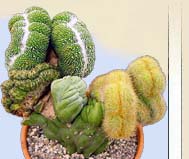
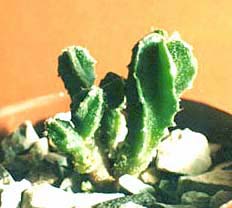
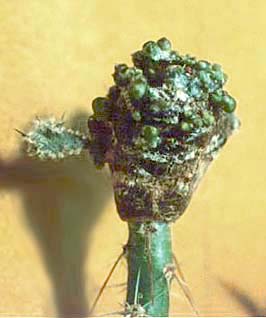
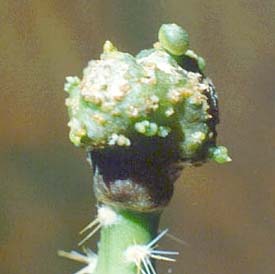
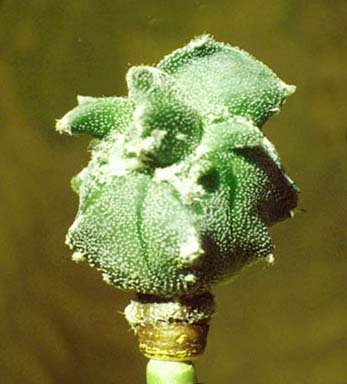
As the subject for experiments I chose Astrophytum myriostigma, Setiechinopsis mirabilis and Mammillaria lanata. The most sensitive were Astrophytums (photo 3-8). To the contrary Mammillarias essentially didn't react.
The shocks over seedlings were:
- electrical discharge (piezoelectric lighter);
- exposure to photo flashes from the distance of 1-2 cm;
- low temperature (3-5 minutes in a freezer).
 The first shock was made about 1 week after germination. First I joined one plate of the lighter to a wire and put the end of the wire into the soil. Then I placed other plate 2-3 mm over seedling, made 3-4 shots (discharges) and moved to other seedling. Consequently I treated all seedlings. Immediately after that I exposed the whole dish with seedlings to the impact photoflash 10 times. Finally I put seedlings into a freezer. Altogether there were four treatments one week apart.
Strangely there were almost no deaths neither slowing down in growth during the experiment. After 4th treatment the results showed up – many seedlings of Astrophytum looked very unusually.
It was unusual that there was no meristem. Ribs and areoles also were indistinguishable. After grafting on Pereiskiopsis they started to grow quickly. The most of them became normal, some (both grafted and on own roots) formed up to 4 heads (photo 3-5).
 Some grafted specimens were covered by small plantlets like cloning callous tissue (photo 6-7).
One plant formed big knobs on the ribs (photo 8).
Seedlings of Setiechinopsis reacted only after few months. The reaction was a polytomy – some of seedlings had up to 4 heads. Mammillarias just formed side shoots what is uncharacteristic for this species and age (5 specimens out of almost 200 seedlings).
Unfortunately I didn't make detailed notes and didn't divide seedlings into different groups per kinds of treatments plus control group. So the results of experiment should be considered preliminary.