INTERESTING CULTIVAR OF MAMMILLARIA DUWEI
Grigoriy Talalayev, Mikhaylovsk, Stavropol Territory
From Russian magazine «Cacti and not only», 2002.
(editor-in-chief Yuri A. Shinkarenko)
Translation Irina TEN, Virginia, USA
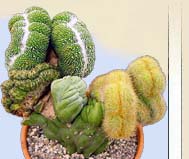
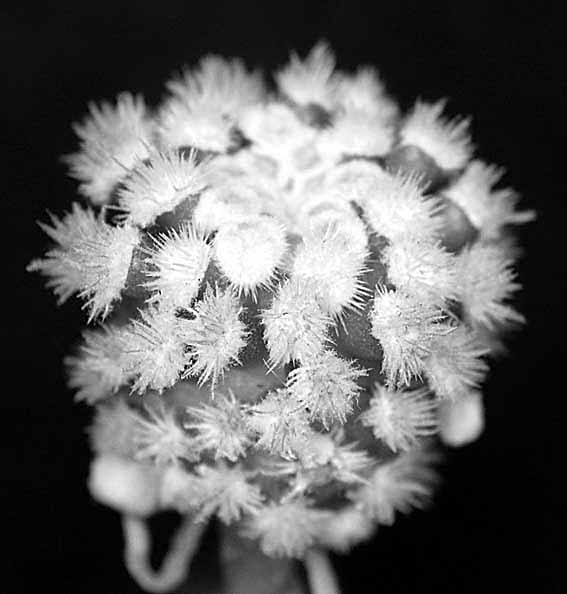
In 2000 I saw small amount of M. duwei seeds. All seedlings had quite typical appearance. After 2 months I grafted 2 seedlings onto Hylocereus using the plate of glass to secure scion what caused the apex damage. Soon after that it became obvious that one of the grafted plants developed atypically: the hooked central spines were missing and radial ones were shorter, the spines arranged in dense pincushions (from editor: most likely the apex was damaged by fungi).
Sincerely, I had doubts about the species definition of this seedling, because the seeds were not mine and I could not guarantee their purity. After some time I cut off and grafted the top of the plant, note that six side shootings emerged on the stump, five from top areoles just like the mother plant and one – from the bottom areole just like a typical M. duwei. After that all doubts about the species definition were settled.
Looking through Russian cacti journals one can find 3 mentions about the similar cultivars: Mammillaria gracilis fa. ("Cacti and not only" Vol. 2, 1997), Notocactus scopa fa. monstrosa ("Cacti and not only ", Vol. 4, 1998) and Krainzia guelzowiana fa. monstrosa ("Cacti and not only", Vol. 3, 2001), that tells us about the possibility of producing similar cultivars from different species of cacti.
I have to note, that the type of growth of my plant changed with time, the point of growth enlonged and the growth became cristate, the size of tubercles became smaller. The plant can be reproduced with ease via the grafting of only one tubercle, because both meristem forming spines and meristem forming side shootings are located at the top of tubercle in the areoles.
I came with a temporary name for this cultivar: Mammillaria duwei cv.'Taschkent' named after my native city and the place where it was produced.
From the editors of "Cacti and not only": we observed that shootings on the plant that the author gave to us emerge both on the top part of areole and on the bottom part, sometimes on one areole.