Intraspecific hybrids of Gymnocalycium
by Nickolay Shemorakov
 |
| Photo 1. |
In the December 2000 issue of e-magazine "Cultivar" I wrote about hybrid seedlings obtained by intercrossing of Gymnocaltcium mihanovichii 'Hibotan Nishiki' x G. m. var. friedrichii 'variegatum' (according to Backeberg K.). In the first year the seedlings with color features made about 5% from the total number of sprouts. In the second year they finally "made their mind" about the color of stem. The number of green (or almost green with feebly marked hues of pink, brown etc.) seedlings exceeded the number of variegated and pure colored (bright crimson, red, brown etc.) seedlings in 3 times (approximately). Hence ratio 19:1 in 2000 was gradually changed to 3:1 in 2001, i. e. number of green seedlings decreased noticeably.
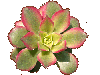
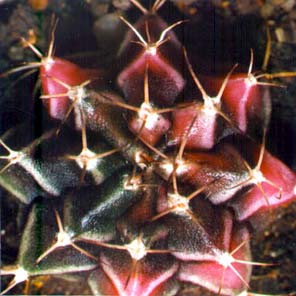
The ratio of green and colored seedlings of F-1 hybrid obtained from crossing of Gymnocaltcium mihanovichii var. friedrichii 'variegatum' x G. m. 'Hibotan Nishiki' changed almost in the same way. Thus not all seedlings reveal their color features in the first year of life. And if you sow seeds from colored parents and find too few colored descendents don't be upset. Give them time and opportunity to grow and to reveal sleeping mutated nuclear genes which will "force" stems of some of them take untypical color (photo 1).
 |
| Photo 2. |
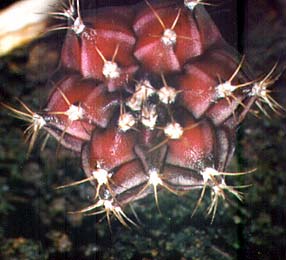
The overwhelming majority of seedlings from hybrids mentioned above grew on their own roots and what is most exciting they didn't cluster even when were two-year old. The exception was the only one seedling of hybrid G. mihanovichii var. friedrichii 'variegatum' x G. m. 'Hibotan Nishiki'. This unique one started offsetting profusely with main stem continuing to grow and reaching the diameter of pea in May 2002. Both main stem and offsets were colored in the same way – entirely pink with greenish tops. The unique combination of genes created the necessary prerequisites for rapid reproduction of this cultivar which was named G. mihanovichii var. friedrichii "Mille Petrozza" (photo 2).
 |
| Photo 3. |
What is called a "hybrid" exactly? If this is a descendant of parents with visible morphological differences then how significant those differences should be? Who, when and where introduced mathematical limits of sum of morphological characteristics which divide one taxon from another? I doubt this is possible and completely agree with the opinion of Ph.D. Volsky G. G.: "Any individual is a hybrid between father and mother". There are no two absolutely identical in genetic sense specimens in Cactaceae and can't be. The exceptions are clones which are only fragments of one individual. Genetic differences cause morphological differences and not always the latter are obvious.
I'd like to tell about a plant grown from the seeds which according to a catalog were not from a hybrid (G. mihanovichii var. friedrichii ).
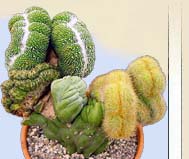
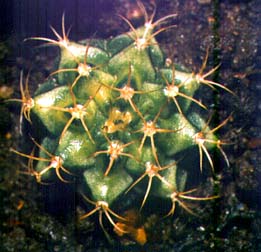
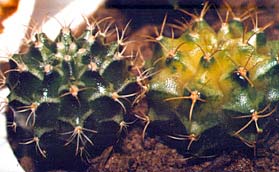
In the first year one of seedlings became two-colored: light green sections alternate with dark green ones (photo 3). A year later light green sections became yellow, dark green ones lightened. The variegated seedling is not behind the common colored brothers in size (photo 4).
 |
| Photo 4. |
This plant is a product of spontaneous mutagenesis because I didn't affect seeds and later seedlings mutagenetically. Simply the recessive nuclear mutations combined in the embryo of one seed (homozygous state) from which this unique cultivar grew. I hope it didn't reveal its coloration completely and it doesn't have a name yet, only G. mihanovichii var. friedrichii "waiting for your propositions". I am preparing its portrait – a botanical description which I will present you.
G. mihanovichii and its varieties are carriers of great number of genes causing mutations of plastids, hence colored seedlings appearing from both hybrid and non-hybrid seeds aren't rare. Thus selection of color features among these species of Gymnocalycium has every prospect of success.