CONTROVERSIAL POINT
by Dmitriy Rogatskin (Smolensk, Russia)
Translated from Russian by Irina Ten
From the Editor: Continuing the discussion started in the article "THE ETERNAL PROBLEM OF TAXONOMY" by Dmitry Semenov we decided to talk again about Gymnocalycium mihanovichii v. friedrichii (see Issue 9 (10) and determine whether the experts agree about its division into two independent species: Gymnocalycium mihanovichii and Gymnocalycium friedrichii. Read the comments by Dmitry Rogatskin who has studied the genus Gymnocalycium for many years.
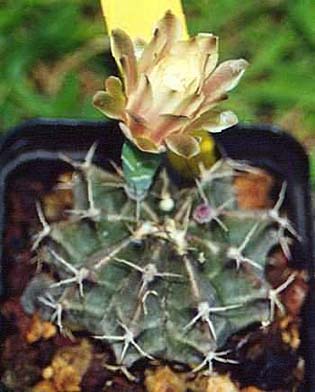 |
| Photo 1. Gymnocalycium mihanovichii |
The name Gymnocalycium mihanovichii v. friedrichii was introduced by Werdermann in 1936.
Pazout suggested the name G. friedrichii nom. inval. in 1964 but it has not been officially approved.
In 1979 Ritter made a description of G. stenopleurum that sometimes can be found under the incorrect name G. mihanovichii v. stenopleurum n. n. (don't confuse it with v. stenogonum).
Thus we have 3 taxa: A - "mihanovichii", B - "friedrichii" and C - "stenopleurum", not taking into account their taxonomic definition. They are basic points of the complex with many transitional forms between.
The joint A-C natural habitat spreads from south to north (North-Western Paraguay): a typical "A" inhabits the very south of the area – south and south-east of province Boqueron; "C" inhabits a limited area on the very north – in Cerro Leon (Lion Mountain) region and has characteristic recognizable habitus; for "B" all the area between two mentioned points is indicated.
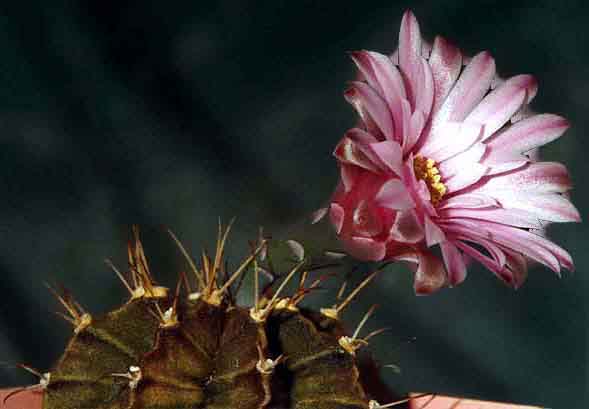 |
| Photo 2. Gymnocalycium friedrichii |
The most distinguishable difference between taxa is a flower color: "A" – yellow, not fully opening; "B" – pink, fully opening; "C" – white, fully opening. In other aspects "B" can be considered as an intervening form.
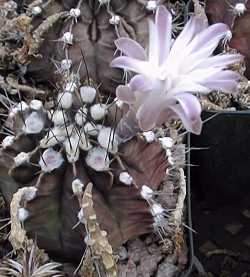 |
| Photo 3. Gymnocalycium stenopleurum |
Nowadays it's hard to find a good specimen of "friedrichii" in collections, with good luck you'll find only descendants from old specimens, and "stenopleurum" taxon could hardly be used for obtaining colored forms.
Currently there are three versions put forward by the experts.
- Pazout described under the name "G. friedrichii" true G. stenopleurum but the description was incomplete and wasn't accepted therefore;
- G. mihanovichii v. friedrichii by Werdermann and G. friedrichii by Pazout are synonyms of G. stenopleurum;
- G. friedrichii is an independent taxon; however there is taxonomic confusion about it and its status is not clearly determined.
Thereby we could only wait until the experts involved in analysis of these three taxa will make their revision and come out with final conclusion.
The main distinctions of G. friedrichii from G. mihanovichii are:
- G. friedrichii has purplish pink, wide open flowers and well-pronounced polymorphism of spines. Besides it has tall slender ribs and roller-shaped prominent thickening around areoles.
- G. mihanovichii has wider, lower ribs, in juvenile plants divided into separate chins, in maturity every rib have flat surface and a pleat above each areole. But the essential thing is its pale or brownish-yellow, not fully opening flower.
The photos show all three taxa.