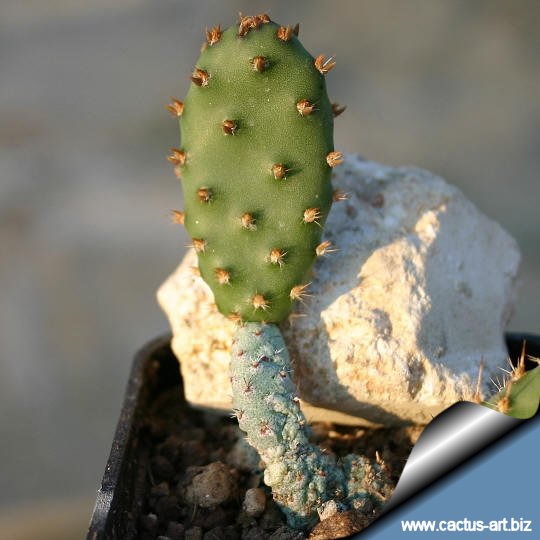
A new cactus chimera - Ortegocactus skin on Opuntia body
Valentino Vallicelli
"Cactus Art"
From the Editor: The information below is from the page Cactus curiosities by Valentino Vallicelli, whose site CACTUS ART is very well-known among C&S fans all over the world. It’s not the first appearance of this master on the pages of our e-magazine and we heartily hope that it isn’t the last either. Valentino Vallicelli doesn’t cease to amaze our readers.
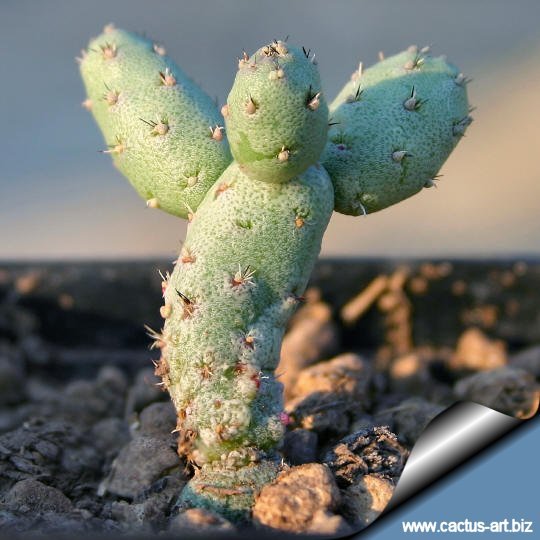
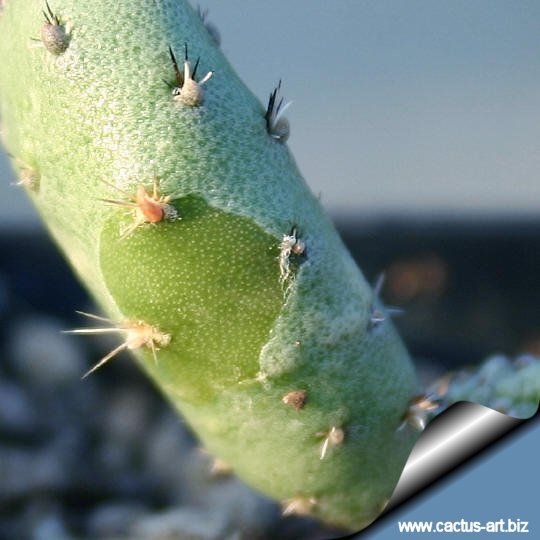
+Ortegopuntia cv. "Percy" (see photos). "Chimera" i is an organism that is made up of cells of two different origins. Only a very few chimerical cacti are known, this new and very rare plant is a graft hybrid containing cells of Opuntia compressa and Ortegocactus macdougalli.
Scientific Name: +Ortegopuntia cv. Percy - Ortegocactus macdougalli + Opuntia compressa. Origin of the chimera: Found and selected in the cactus art nursery in the spring 2004 by Vallicelli Valentino
Etymology: Graft-chimeras can be given their own genus name (which is a combination of the two constituent generic names) preceded by a "+" sign. + Ortegopuntia derives from the combination of Ortegocactus and Opuntia.
Description: This original plant appeared unexpectedly in a grafted plant, the graft-chimera sprouted up as a small branch from the joint-point of the stock and scion, from the callus containing the tissues of both species. This is a very slow growing plant with an external layer of epidermal cells of Ortegocactus macdougalli that cover the second inner layer of tissues of Opuntia compressa like a glove. The plant colour is the unmistakable grey-blue metallic tone of Ortegocactus, but the plant shape is that of a minuscule Opuntia with small irregular cladodes up to 3-5 cm long. This plant is quite unstable and have a tendency to revert to common Opuntia shoots.
Cultivation: We didn’t have much time for testing the cultivation requirements of this brand new chimera. The plant seems to be easy in cultivation, the main difficulty is to eliminate the shoots that revert to the Opuntia type, so it is advisable to water the plant moderately, in fact over-feeding and over-watering may enhance the growth of the more vigorous Opuntia tissues. This is a particularly slow growing plant and needs a sunny and warm exposure, and possibly winter temperature not lower than 5-10C. Good air ventilation is a must.
History: Chimeras in the Cactaceae family are very rare and quite unusual in cultivation. The first chimera +Hylocalycium (Hylocereus undatus + Gymnocalycium mihanovichii forma rubra "cv. Red Hibotan") was described in Cactus & Succ. J. of America in 1987. Recently there appeared some more information in the internet about other chimerical cacti, for example:
+Myrtillocalycium (Myrtillocactus geometrizans + Gymnocalycium cv. Red Hibotan ),
Gymnocalycium mihanovichii v. fleischerianum + Echinopsis tubiflora.
Gymnocalycium mihanovichii v. fleischerianum + Hylocereus guatemalensis
Ariocarpus retusus + Echinopsis eyriesii (graft-chimeras appear more frequently among Ariocarpus than among any other genus if they are grafted onto Echinopsis sp. or Myrtillocactus geometrizans.)
In some ornamental plants chimeras may be the result of lengthwise implanting and sophisticated techniques, a possible methods include cutting the stem at the midpoint and combining the lobes of stock and scion. It is supposed that the miscellaneous tissues in the joint point can accrete and give life to an adventitious new plant "chimera". But - as we know - nobody till now has succeeded to make cacti chimera on purpose. Circumstances which cause the chimera to appear include huge numbers of graftings.